Preface
Text / Jut Art Museum
“The question of what kind of city we want cannot be divorced from the question of what kind of people we want to be.”——David Harvey, Rebel Cities: From the Right to the City to the Urban Revolution, 2012
Cities are ever-evolving organisms, defined by constant growth, construction, and expansion. Like beacons in the darkness, they attract humans to gather, interact, and survive, becoming the vessels of culture and civilization. However, the evolution of a city is not a linear progression but a cycle of rise and fall or restoration and rupture amidst mounting tensions and changes. These urban conditions and life experiences forced into view by radical upheavals are exactly what this exhibition seeks to explore.
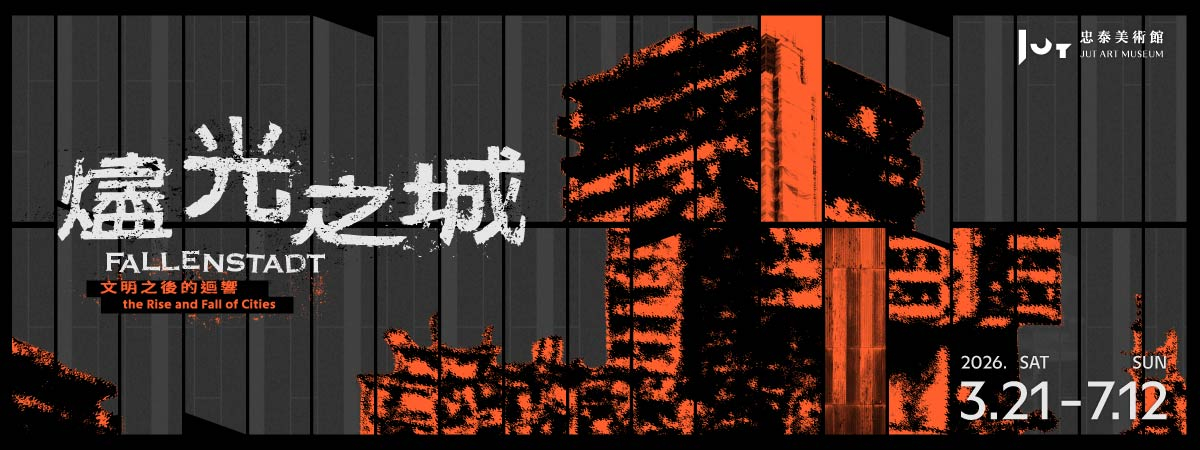
As a rich tapestry of history, culture, and future visions, the exhibition Fallenstadt: the Rise and Fall of Cities observes and reflects on the cyclical nature of human civilization. Structural cataclysms such as wars, climate catastrophes, industrial transformations, and the imbalance of power have left many cities in a state of precarity. These cities undergo repeated cycles of collapse, mending, and rebirth, manifesting their inherent fragility and resilience. The metamorphosis of a city is tantamount to blazing flames. While the flames may go out, the embers never die, perpetuating the cycle of prosperity and decline. Co-curated by Nobuo Takamori and the Jut Art Museum team, this exhibition focuses on non-occidental urban experiences that are less covered by mainstream narratives and have relatively limited discursive power. Through the works of 11 artists and collectives from the Philippines, Sri Lanka, Syria, Romania, South Korea, and Taiwan, this exhibition rethinks what a “city” truly looks like under varying historical, political, and economic conditions. From the demolition of historic buildings in Bucharest, the dystopian urban visions of Damascus, and the e-waste settlements of Agbogbloshie in Ghana, to the Umbrella Movement in Hong Kong and the relocation caused by industrial transformation in Tainan, Taiwan, these seemingly distant urban stories mirror the very rupture, reorganization, and remaking that our own modern cities are experiencing.
Since its inception in 2016, the Jut Art Museum has consistently addressed issues concerning the “city” and the “future” through a succession of contemporary art exhibitions, such as A Non-Existent Place, The Flying Land, Paradise Lost, and Broken Landscapes. The current exhibition, Fallenstadt, not only responds to the museum’s decade-long dedication to urban issues, but also stands at this critical juncture in history to raise essential questions about urban civilization, future lifestyles, and our collective imagination, thereby opening up a new space for further dialectical inquiry, dialogue, and contemplation.
Curator Statement
Fallenstadt: the Rise and Fall of Cities
Text / Nobuo Takamori
Since the first cities rose from the earth millennia ago, they have stood as a defining hallmark of human civilization. Agglomerating considerable populations and wealth, cities have fostered the development of cultural assets and innovative technologies throughout history. Statistically speaking, however, urban civilization does not necessarily equate to the concept of a comfortable existence. More than 50% of the world’s total population resides in cities today. However, not every city that accommodates this massive influx of people aligns with our idealized vision of urban life. Currently, there are over 80 cities worldwide with populations exceeding 5 million, a scale comparable to that of the Greater Taipei Area. Yet, among these megacities scattered across the globe, nearly half fail to provide the majority of their inhabitants with basic public services.
While cities across the developing world appear fraught with existential crises, their integration into the globalized trade system places them in a paradoxical position. They serve as hubs for trading and processing the detritus of global overproduction at the price of bearing greater environmental risks. In this sense, as humanity is ushered into an era characterized by increasingly severe living conditions and geopolitical complexities, it remains debatable whether the idealized cities of developed countries are better equipped to withstand extreme circumstances, or if the emerging cities of the developing world will prove to be the “hidden champions” in the race for survival. Our experience of the COVID-19 pandemic showed that even affluent, idealized cities may expose their potential vulnerabilities if they lack the requisite resilience and flexibility to address unforeseen, large-scale catastrophes.
Featuring artists from Taiwan, South Korea, the Philippines, Sri Lanka, Syria, Romania, and Germany, this exhibition presents scenes that resonate with Italo Calvino’s depictions in Invisible Cities. The grandeur and decadence, the courage and absurdity, as well as the wisdom and annihilation of human civilization find expression in the cities beleaguered by flooding, self-abasement, crises, global detritus, and encroaching warfare. Cities serve as a portrayal of humanity per se. Their multifaceted façades and complexities are projections of human consciousness. Acting as a mirror, cities reflect our pride, aspirations, morality, dread, desires, and depravity. Welcome to Fallenstadt, a place where reverberations linger just before the torch of civilization is extinguished.
Artists
- Elom 20ce (Togo)
- Ayham Jabr (Syria)
- Isabel and Alfredo Aquilizan, The Fruitjuice Factori Studio Collective (Philippines/ Australia)
- Abdul Halik Azeez (Sri Lanka)
- Shu-Kai Lin (Taiwan)
- Ayoung Kim (South Korea)
- Wayne Ashley (FuturePerfect Studio) (U.S.A)
- Mark Salvatus (Philippines)
- Gregor Kasper (Germany)
- Musquiqui Chihying (Taiwan)
- Dean-E Mei (Taiwan)
- Hai-Hsin Huang (Taiwan)
- Sebastian Moldovan (Romania)
- Kuen-Lin Tsai (Taiwan)
*The list shows in order of stroke numbers by artists’ first character of their Mandarin surnames.
- Venue|Jut Art Museum (No.178, Sec. 3, Civic Blvd., Da'an Dist., Taipei City 106, Taiwan)
- Opening Hours|TUE-SUN 10:00-18:00 (Closed on Mondays)
- Admission|General TWD 150, Concessions TWD 100 (Student, seniors aged 65 and above, and groups of 10 or more)
- Free Admission for the disabled and a companion, children aged 12 and under (Concessions or Free Admission upon presentation of valid proof)
- Student Day on WED|Free Admission once on Wednesdays upon presentation of valid student ID
- Organizer|Jut Art Museum
- Cultural Partners|Australian Office, Taiwan Contemporary Culture Lab, eslite member
- Official Hotel Partner|MGH Mitsui Garden Hotel Taipei Zhongxiao
- Media Partners|Art Emperor, La Vie, The Reporter
- Event Partners|NOKE JUT RETAIL, ONIBUS
Exhibition Team
Exhibition Supervisors|Aaron Y. L. Lee, Alex Y. H. Lee, Shan-Shan Huang
Exhibition Coordinator|Tsuei-Yi Jang
Coordinators|Ying-Peng Chen, Yen-Hsiu Chen, Chia-Ching Lin, Ying-Hsuan Liu
Communications and Marketing Coordinator|Szu-An Chen
Communications and Marketing|Yen-Shan Li, Yu-Chin Liou, Yi-Ning Lin, Chia-Chen Tsao
Public Service|Tsung-Ping Hung, Pei-Chun Tsai, Yu-Tzu Lin
Administration Coordinator|Hsin-Yi Lin
Visual Designer|Flowing Design
Graphic Designer|Tsai-Yuan Tsai
Lighting Designer|Chung-Chang Ho
Multimedia Design|UN ART